Tap It Out: Why Doctors and Therapists Are Starting to Take Casual Gaming Seriously as a Stress Tool
There's a therapist in Denver who assigns homework that would have seemed absurd ten years ago. Between sessions, she asks certain clients to play mobile games — specifically, simple arcade-style titles with repetitive mechanics, clear feedback loops, and no complex narrative to follow. The assignment isn't casual. It's intentional, documented, and, by her account, producing results she didn't fully anticipate when she started.
"I was skeptical of myself at first," she admits. "We're trained to be cautious about screen time. But what I was seeing in certain clients — particularly those dealing with generalized anxiety — was that these short gaming sessions were functioning as a kind of structured distraction that actually allowed their nervous systems to settle."
She's not alone in noticing this. Across the US, a quiet but growing conversation is happening at the intersection of mental health practice and casual gaming — and for the first time in a long time, the conversation isn't about harm.
A Different Kind of Distraction
The word "distraction" has a bad reputation in wellness circles. Avoidance, after all, is generally considered a counterproductive anxiety management strategy. But researchers are starting to draw a distinction between avoidance that delays processing and distraction that creates a genuine neurological pause — a window in which the stress response can de-escalate.
Arcade-style games, it turns out, may be unusually good at producing that pause. Here's why: games with simple, repetitive mechanics — think matching tiles, tapping rhythms, or guiding a character through an obstacle course — require just enough cognitive engagement to occupy the brain's pattern-recognition systems without triggering the higher-order thinking where anxiety tends to live.
In other words, you're too busy tapping to catastrophize. And if the session is short enough, you come out the other side with a nervous system that's had a few minutes to stop running hot.
A 2022 study from researchers at a California university found that participants who played a simple mobile puzzle game for ten minutes before a stressful task reported significantly lower anxiety levels than those who sat quietly or browsed social media. The social media finding, notably, went the other direction — screen time isn't the variable. The type of engagement is.
The Mechanics of Calm
Game designers have long known that certain mechanics produce a sensation they call "flow" — the absorption state where time seems to stop and external concerns fade. Psychologist Mihaly Csikszentmihalyi described this state decades ago as one of the most reliable sources of positive experience available to humans. Arcade games, almost by accident, became very good at inducing it.
The key ingredients are consistent: a clear goal, immediate feedback, a difficulty curve that stays just ahead of the player's current skill level, and enough repetition to build muscle memory. Put those together and you get a system that absorbs attention efficiently and rewards continued engagement with small, regular dopamine hits.
"From a neuroscience perspective, what's happening in a well-designed casual game is actually quite elegant," says a researcher who studies reward systems and digital behavior. "You're getting a predictable, controllable environment with clear cause and effect. For someone whose anxiety is driven by uncertainty and loss of control, that's genuinely therapeutic — not metaphorically, but mechanically."
Workplace Adoption Is Already Happening
Outside clinical settings, the corporate world has been running its own informal experiments. A handful of forward-thinking US companies have quietly introduced gaming breaks — structured, short windows where employees are actively encouraged to play casual games — as part of broader employee wellness programs.
The rationale is both humanistic and practical. Chronic workplace stress costs American employers an estimated $300 billion annually in lost productivity, absenteeism, and healthcare costs. If a ten-minute gaming break can meaningfully reduce cortisol levels and improve afternoon focus, the ROI math isn't complicated.
Employee response, where these programs have been piloted, has been largely positive — with one recurring caveat. Workers want the break to feel genuinely unstructured. The moment a gaming session gets tied to performance metrics or productivity tracking, the stress-relief benefit collapses. You can't relax while being evaluated on your relaxation.
"The game has to be a game," says one HR consultant who has advised on wellness program design. "The second it becomes an assignment, the psychology shifts completely."
The Skeptics Have a Point
Not everyone in the mental health community is ready to prescribe Tetris. Legitimate concerns exist, and they deserve airtime.
The most substantive critique is the substitution problem: if gaming becomes a go-to anxiety management tool, does it crowd out more effective long-term interventions like therapy, exercise, or mindfulness practice? A ten-minute game session might lower your heart rate in the moment, but it doesn't address the underlying thought patterns driving chronic anxiety.
There's also the tolerance question. The same mechanisms that make arcade games effective at producing calm — the reward loops, the dopamine hits, the sense of control — are also the mechanisms that can tip into compulsive use. The line between therapeutic gaming and avoidant gaming isn't always obvious from the inside.
"I'm not opposed to the idea that gaming can be a useful tool," says a licensed clinical psychologist based in Chicago. "I'm cautious about it becoming a replacement for the harder work. It's a pressure valve, not a fix."
That's a fair distinction. The therapists and researchers most enthusiastic about gaming as a wellness tool are also the most careful to frame it as one component of a broader strategy — not a standalone solution.
What the Players Already Know
Here's the thing: none of this is news to the millions of Americans who already use casual gaming this way, even if they've never thought about it in clinical terms.
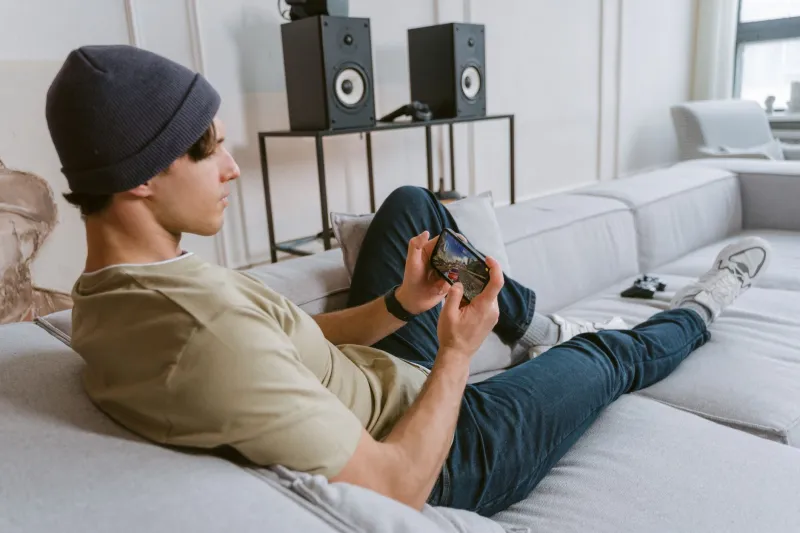
Ask around. You'll find the person who plays a quick arcade game on their phone every night before bed because it's the only thing that turns their brain off. The parent who sneaks five minutes of a match-three puzzle during a chaotic afternoon because it's the closest thing to quiet they're going to get. The college student who fires up a simple mobile game between classes because it's cheaper than coffee and more effective than deep breathing.
These players don't need a research paper to tell them it works. They figured it out empirically, session by session, and they kept coming back because the evidence was right there in how they felt afterward.
Maybe that's where the real story is — not in the labs or the clinical trials, but in the millions of small, unremarkable moments where someone picked up their phone, played something fast and simple, and came back to their day a little bit lighter. That's been happening for years. Science is just starting to catch up.