Press Start, Together: The Surprising Way Arcade Gaming Is Bringing Families Closer
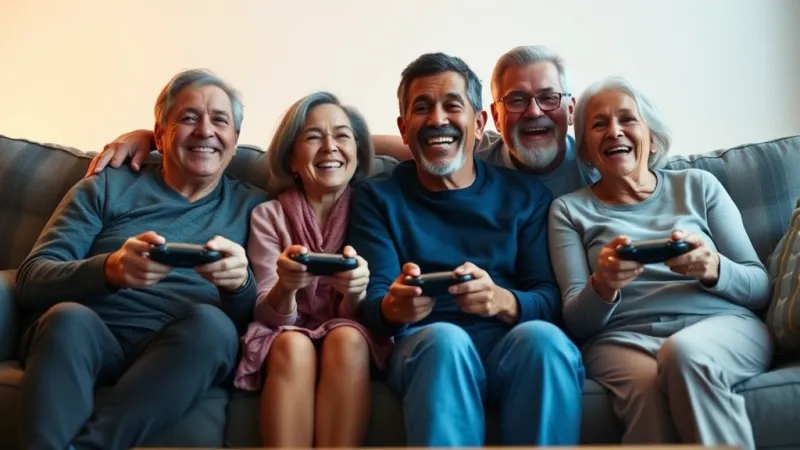
Photo: family playing mobile games together on couch multigenerational fun, via gameforgedaily.com
Marcus, a 19-year-old from Columbus, Ohio, didn't expect his 54-year-old father to get hooked on a mobile puzzle game. "He kept watching me play during road trips," Marcus said. "One day he just asked if he could try. Now he texts me his scores."
That exchange — casual, unplanned, sparked by curiosity — is playing out in households across the country. A new kind of gaming culture is emerging, one where the youngest players in the family are the ones leading older generations back to the screen. And the games doing the heavy lifting aren't flashy open-world epics or competitive shooters. They're arcade-style titles: simple to pick up, satisfying to master, and packed with the kind of nostalgic energy that hits different when you grew up putting quarters in a machine at the local pizza place.
The Nostalgia Bridge
For parents and grandparents who came of age in the '70s, '80s, or '90s, arcade gaming isn't a new concept — it's a memory. The local arcade was a social hub. Pac-Man, Galaga, Frogger, Centipede — these weren't just games. They were experiences shared with friends, siblings, and first dates.
When Gen Z players discover retro-style titles on mobile or browser platforms, they're often unknowingly tapping into something their parents already love. The visual language of pixel art, the chip-tune sound effects, the straightforward "dodge this, collect that" gameplay loops — all of it triggers recognition in older players who thought they'd moved on from gaming decades ago.
"I showed my mom a game on my phone that looked a lot like Breakout," said Destiny, a 22-year-old from Atlanta. "She said, 'Oh, I used to be incredible at this.' Twenty minutes later she had a higher score than me. I was kind of embarrassed."
That moment of role reversal — where the older player suddenly becomes the expert — is a recurring theme in multigenerational gaming conversations. And it matters more than it might seem.
Why Simpler Games Work Better for Everyone
One of the biggest barriers to family gaming has historically been complexity. Modern console games can require dozens of hours of onboarding before they become fun. Button layouts are dense. Menus are layered. The skill gap between an experienced gamer and a newcomer can feel insurmountable.
Arcade-style games sidestep all of that. The rules are usually explainable in one sentence. Controls are minimal — often just a tap or a swipe on mobile. The feedback loop is immediate: you either survived or you didn't, and you can try again in three seconds.
This accessibility is what makes casual and arcade-style games the perfect entry point for players who don't identify as "gamers." There's no intimidating learning curve, no commitment to a long story arc, and no social pressure to perform at a high level. You just play.
For families specifically, that low barrier creates space for genuine shared experience rather than one person watching another navigate a complex world they don't understand.
The Living Room Comeback
COVID-era lockdowns accelerated something that was already quietly building. With families spending more time at home together, gaming became a go-to activity — and not just for kids. Board games saw a massive resurgence. So did casual video games and mobile titles.
Many families discovered that gaming, in its most accessible form, scratches the same itch as game night. It's competitive without being cutthroat. It's social without requiring everyone to be in the same city. And for extended families separated by geography, mobile games became an unexpected way to stay connected — sharing scores, challenging each other to beat their best, texting reactions.
Janet, a 51-year-old from Phoenix, described playing an online word puzzle game with her daughter in Seattle every morning. "We don't always have time to call," she said. "But we both play the same daily puzzle and then text each other about it. It's become our thing."
What Gen Z Brings to the Table
Younger players aren't just passive participants in this shift — they're actively driving it. Gen Z grew up native to mobile technology, streaming culture, and online communities. They understand intuitively how to find great free games, how to share them, and how to make gaming feel social even when it's happening on a tiny screen.
This generation is also remarkably unsnobbish about gaming. Unlike some older gaming communities that drew sharp lines between "real" games and casual ones, Gen Z tends to approach gaming as a broad, inclusive spectrum. If it's fun, it counts. That attitude makes them natural ambassadors for bringing less experienced players — including their parents — into the fold.
Many younger players also carry a genuine appreciation for retro aesthetics and vintage game design. Platforms built around classic arcade mechanics aren't seen as outdated — they're seen as cool. That cultural reframing is part of what makes the multigenerational handoff feel so natural right now.
What This Means for the Future of Casual Gaming
The gaming industry is paying attention. Developers building casual and arcade-style titles increasingly design with multigenerational play in mind — simple enough for newcomers, deep enough to reward veterans, and built for the kind of quick sessions that fit into busy family schedules.
Features like asynchronous leaderboards (where family members can compare scores without needing to be online at the same time), shareable challenge links, and low-data mobile play are all elements that support family gaming without demanding it.
The result is a casual gaming landscape that's genuinely more inclusive than it's ever been. Not inclusive in a marketing-speak way — inclusive in the sense that a 14-year-old and a 60-year-old can sit down together, pick up the same game, and both have a great time.
That's not a small thing. In a media environment where everyone's staring at their own screen, consuming their own content, gaming — old-school, arcade-style, pick-up-and-play gaming — is quietly doing something kind of remarkable.
It's bringing people back to the same table.
And occasionally, mom is absolutely destroying everyone's high score.