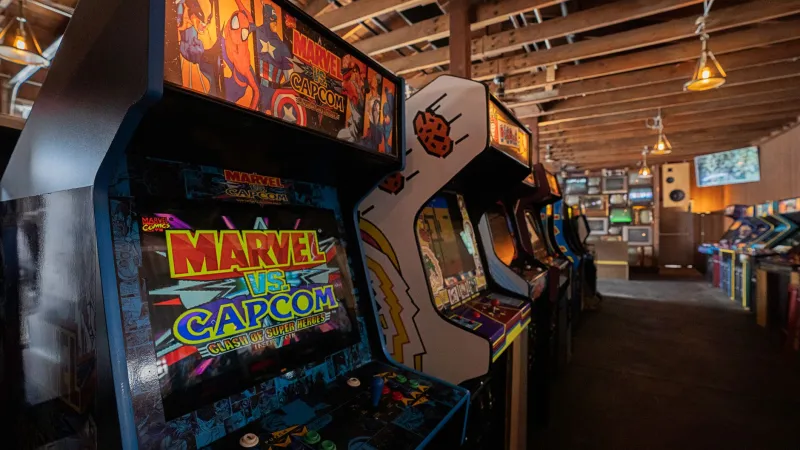
Old School Is the New Cool: Why Retro Arcade Games Are Taking Over Modern Screens

Something funny is happening in gaming right now. While studios are burning hundreds of millions of dollars building sprawling open worlds loaded with battle passes and loot boxes, a growing wave of players is quietly swiping past all of it — straight to games that look like they were born in 1984. Pac-Man clones, space shooters, tile-matching puzzlers. The kind of stuff your dad pumped quarters into at the mall arcade.
And they're not just playing these games. They're obsessed with them.
Retro arcade titles are having a genuine moment on mobile and browser platforms, and it's not just nostalgia doing the heavy lifting. There's a real philosophy shift happening under the surface — one that's reshaping what casual players actually want from their gaming time.
The Backlash Nobody Saw Coming
Spend five minutes on any gaming subreddit and you'll feel the frustration. Players are exhausted. Exhausted by games that demand forty hours before they get interesting. Exhausted by currencies inside currencies, season passes, and mechanics that feel deliberately designed to drain wallets instead of reward skill.
Indie developer Marcus Teel, who runs a two-person studio out of Austin, Texas, put it bluntly: "We started making retro-style arcade games because we were burned out as players ourselves. We wanted something you could pick up, get good at, and feel proud of — without a credit card involved."
That sentiment is echoing across the industry. Gaming analysts have pointed to a measurable uptick in downloads for arcade-style titles throughout 2023 and into 2024, particularly among the 25-to-40 demographic — players who grew up with the originals but now have maybe fifteen minutes between meetings to squeeze in a session.
The appeal isn't just nostalgia, though that's definitely part of it. It's about clarity. Classic arcade design is ruthlessly honest. You know exactly what the game wants from you. Get a high score. Survive longer. Beat your last run. No lore dumps. No tutorial that takes forty-five minutes. Just play.
Skill Beats Spending — Finally
One of the biggest draws pulling players back to retro-style games is deceptively simple: your progress actually means something.
In a landscape dominated by games where the guy who dropped $200 on gear has a structural advantage, there's something almost radical about a game where the only variable is how good you are. Old-school arcade design was built around that idea from day one. The machine didn't care how much money you had. It cared whether you could dodge, react, and think faster than the last guy.
Gaming analyst Priya Okafor, who tracks mobile trends for a Chicago-based research firm, sees this as a direct reaction to years of aggressive monetization. "Players have become really savvy," she says. "They can smell pay-to-win mechanics from a mile away now. When they find something that's purely skill-based, it stands out. It feels almost rebellious at this point."
That skill-first design philosophy is exactly what platforms like 1112 Game are built around. The games are fast, fair, and genuinely satisfying to master — the kind of experience where hitting a personal best feels earned, not purchased.
Why Stripped-Down Actually Hits Harder
Here's the counterintuitive truth about retro arcade games: less really is more.
Modern AAA releases often bury their best moments under layers of complexity. By the time you've unlocked the mechanic that makes the game fun, you've already invested hours just getting there. Arcade design flips that entirely. The fun is immediate. The learning curve is steep but fair. And because the mechanics are simple, mastering them feels genuinely rewarding.
Take the classic space shooter format. One ship. Waves of enemies. A score counter ticking up. That's it. But within that framework, there's enormous depth — pattern recognition, risk management, split-second decision making. Players who dig into it find layers they didn't expect. And they keep coming back, not because an algorithm nudged them, but because they want to get better.
Marcus Teel describes it as "honest design." "Every mechanic in a classic arcade game exists to challenge you or reward you. Nothing is in there to manipulate your spending habits. That honesty builds real trust with players."
The Mobile Platform Sweet Spot
There's also a practical reason retro arcade games are crushing it right now: they're perfect for the way Americans actually play games in 2024.
The average mobile gaming session in the US lasts somewhere between eight and fifteen minutes. That's not a lot of time to make progress in a sprawling RPG or a live-service shooter. But it's plenty of time to run through three or four rounds of a well-designed arcade title, chase a high score, and walk away feeling like you actually did something.
The pick-up-and-play design that defined arcade cabinets in the '80s maps almost perfectly onto the stolen-moment gaming habits of today's players. Waiting for coffee. Sitting in the carpool line. Five minutes before a Zoom call. Retro arcade games were built for exactly this kind of fragmented attention, decades before smartphones existed.
Priya Okafor points to session data as proof. "Engagement metrics for arcade-style games on mobile are consistently strong. Players return more frequently, and they tend to have longer overall relationships with these titles compared to more complex games that require sustained attention to progress."
What Indie Developers Are Getting Right
The studios driving this retro revival aren't the big players. They're small teams — sometimes just one or two people — who are making games they actually want to play. And that authenticity is coming through in the final product.
Rather than chasing trends or reverse-engineering what keeps players spending, these developers are asking a simpler question: Is this fun? It sounds obvious, but in an industry increasingly driven by engagement metrics and monetization models, it's actually kind of radical.
The result is a growing library of arcade-style titles that feel genuinely fresh precisely because they're not trying to be everything to everyone. They're tight, focused, and satisfying in the way that a perfectly thrown strike is satisfying. Clean. Purposeful. Immediately rewarding.
The Score Still Matters
Maybe the most telling sign of retro gaming's comeback is how players talk about it. High scores are back as a cultural currency. Sharing a screenshot of a personal best, challenging a friend to beat your run, grinding to crack the top of a leaderboard — these are the conversations happening in gaming communities right now, and they feel genuinely excited in a way that "I unlocked the battle pass skin" never quite managed.
There's something timeless about the pursuit of a number on a screen. It was enough to keep players feeding quarters into machines for decades. Turns out, it's still enough. Maybe more than ever.
The arcade never really died. It just needed the right moment to remind everyone why it mattered in the first place. In 2024, that moment is here — and if the player counts are any indication, it's not going anywhere.