From Quarters to Clicks: The Arcade Games That Built American Gaming DNA
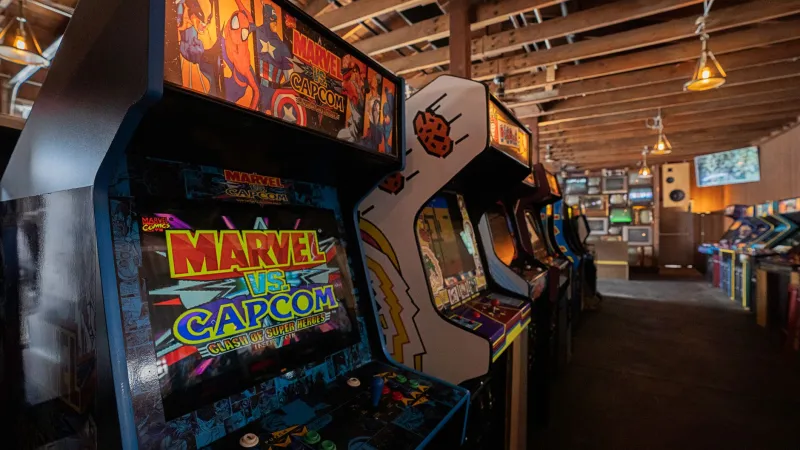
There's something almost sacred about the sound of a coin dropping into a slot. That metallic clink — followed by a screen flickering to life — was the starting gun for millions of American kids who grew up in the golden age of arcades. Long before mobile gaming and browser-based platforms made entertainment instantly accessible, you had to earn your fun, one quarter at a time.
At 1112 Game, we think about that legacy a lot. The spirit of arcade gaming — fast, fun, endlessly replayable — is exactly what we try to capture in every game on our platform. So let's take a walk through the titles that built this culture from the ground up.
1. Pac-Man (1980) — The One That Caused an Actual Fever
If you were alive in 1980s America, Pac-Man wasn't just a game — it was a cultural event. Pac-Man fever was a real phenomenon, complete with a novelty pop song that hit the Billboard charts. The game's simple loop (eat dots, dodge ghosts, eat power pellet, turn the tables) introduced the concept of casual mastery to mainstream America. You didn't need to be a gamer. You just needed a quarter and a few minutes.
That accessibility? That's the direct ancestor of every mobile game you've played in the last decade.
2. Donkey Kong (1981) — The Birth of the Hero's Journey
Before Mario was Mario, he was Jumpman — a tiny carpenter trying to rescue a kidnapped girlfriend from a giant ape. Donkey Kong introduced American players to the idea of a narrative inside an arcade game. Suddenly, you weren't just chasing a high score. You were rooting for someone. That emotional hook changed everything.
3. Space Invaders (1978) — The Game That Caused a Coin Shortage
Legend has it that Space Invaders was so wildly popular in Japan that it caused a national shortage of 100-yen coins. By the time it hit American arcades, the hysteria had followed. Rows of descending aliens, a lone cannon, and a ticking pace that sped up as enemies fell — it was pure tension design. Every modern wave-based mobile game owes a debt to this one.
4. Street Fighter II (1991) — When Arcades Became Social Arenas
Street Fighter II didn't just bring fighting games to mainstream America — it turned arcade cabinets into social battlegrounds. Strangers would line up quarters on the machine's bezel to call next game. Rivalries formed. Friendships were forged over Hadoukens and Shoryukens. The competitive, community-driven energy Street Fighter II sparked is still alive today in every online leaderboard and multiplayer mode.
5. Mortal Kombat (1992) — The Game That Made Washington Pay Attention
Mortal Kombat didn't just push buttons — it pushed Congress. The game's graphic fatalities sparked Senate hearings that ultimately led to the creation of the ESRB ratings system. Love it or hate it, Mortal Kombat forced America to take gaming seriously as a cultural and political force. That's a legacy no other arcade title can claim.
6. Ms. Pac-Man (1982) — Expanding the Audience
Ms. Pac-Man did something quietly revolutionary: it broadened who felt welcome in arcades. With a female protagonist, faster gameplay, and randomized maze layouts that prevented players from memorizing patterns, Ms. Pac-Man was arguably a better game than the original. It also signaled that gaming wasn't just for one demographic — a lesson the industry is still learning.
7. Galaga (1981) — The Art of the Perfect Loop
Ask any arcade veteran about Galaga and watch their eyes light up. The game's enemy formation patterns, the thrill of rescuing a captured ship to double your firepower, the hypnotic rhythm of it all — Galaga perfected the concept of a game loop that rewards repetition. That concept is the backbone of every casual mobile game built for quick sessions and endless replayability.
8. Frogger (1981) — Everyday Danger as Entertainment
Cross a busy highway. Navigate a treacherous river. Don't die. Frogger's genius was making mundane, relatable danger into nail-biting entertainment. It was also one of the first arcade games to feel genuinely different every run, with randomized traffic patterns keeping players on their toes. Frogger's DNA lives on in every endless runner and reflex-based browser game you'll find today.
9. Centipede (1980) — The Game That Welcomed Everyone
Centipede had a trackball controller and a design that felt approachable to players who'd never touched a joystick. Atari reportedly noticed that women and younger kids gravitated toward Centipede more than other games of the era — and that observation quietly shifted how developers thought about designing for broader audiences.
10. Asteroids (1979) — Physics Before Physics Engines
Asteroids gave players the first real taste of momentum in a game. Your ship didn't stop when you let go of the button — it drifted. That physics-based movement felt revolutionary in 1979 and demanded a new kind of player skill: anticipation. Asteroids also introduced the high score initials entry system, turning personal achievement into a public declaration. Three letters. Infinite pride.
11. NBA Jam (1993) — When Arcades Went Mainstream Pop Culture
He's on fire. Two-on-two basketball, exaggerated dunks that defied gravity, and commentary so quotable it entered everyday American speech — NBA Jam was the moment arcade gaming fully merged with mainstream pop culture. Sports fans who'd never touched a joystick were suddenly feeding quarters into machines at Pizza Hut. NBA Jam proved that the right license plus the right game design could pull anyone into the arcade ecosystem.
The 12th Game: The One That Started It All
Here's where it gets interesting — and where the number 1112 means something more than just a domain name.
Before Pac-Man. Before Space Invaders. Before any of the titles above had a chance to shape American culture, there was Computer Space (1971), designed by Nolan Bushnell and Ted Dabney — the same duo who would go on to found Atari.
Computer Space was the first commercially sold arcade video game in history. It flopped. Hard. The controls were considered too complicated, the concept too alien (pun intended) for bar patrons who just wanted a beer and a jukebox. Bushnell famously said the game was too hard for drunk people.
But here's the thing: that failure taught Bushnell everything he needed to know. Simplify. Make it intuitive. Make it fun for everyone, not just tech enthusiasts. Those lessons led directly to Pong in 1972, which launched Atari, which sparked the arcade boom, which gave birth to every single game on this list.
Computer Space didn't succeed — but it started everything. It was the quiet origin point, the overlooked first chapter that made all the others possible.
At 1112 Game, that story resonates deeply. Eleven iconic games that shaped a culture, and the twelfth that quietly made them all possible. That's the spirit baked into everything we do — honoring the history of casual, pick-up-and-play gaming while building something new for the next generation of players.
The Arcade Isn't Dead — It Just Moved
Walk into a Dave & Buster's on a Friday night, or check out the barcade scene that's exploded in cities like Austin, Chicago, and Brooklyn, and you'll see it clearly: arcade culture never died. It evolved. The same joy that made a kid pump quarters into a Galaga cabinet in 1981 is the same feeling that keeps players coming back to casual games on their phones and browsers today.
The format changed. The feeling didn't.
That's the whole game. And we're just getting started.